During the third quarter of 2026, renewed inflation concerns pushed the 10-year Treasury yield approximately 85 basis points higher to nearly 5.3%. Municipal yields followed, and the Morningstar US Municipal Bond Index declined 5.9% during the quarter. As rates moved higher and prices moved lower, a growing portion of the municipal bond market began trading at discounts to par value.
While higher yields have improved income opportunities, discounted municipal bonds should be evaluated on an after tax basis rather than on stated yield alone. Depending on the purchase price, two bonds with similar yields can produce materially different after-tax outcomes. For investors evaluating discounted municipal bonds, the distinction often comes down to how the market discount is ultimately taxed.
Under the IRS de minimis rule, the tax treatment of a bond's market discount depends on both the purchase price and the bond's remaining years to maturity. If a bond is purchased at a discount that exceeds a threshold equal to 0.25% of its stated redemption value multiplied by its remaining years to maturity, the market discount is generally subject to ordinary-income treatment when recognized. Discounts that fall within the threshold are generally treated as capital gains. As a result, de minimis can materially affect the after-tax return of a discounted municipal bond and, in some cases, the price investors are willing to pay for it.
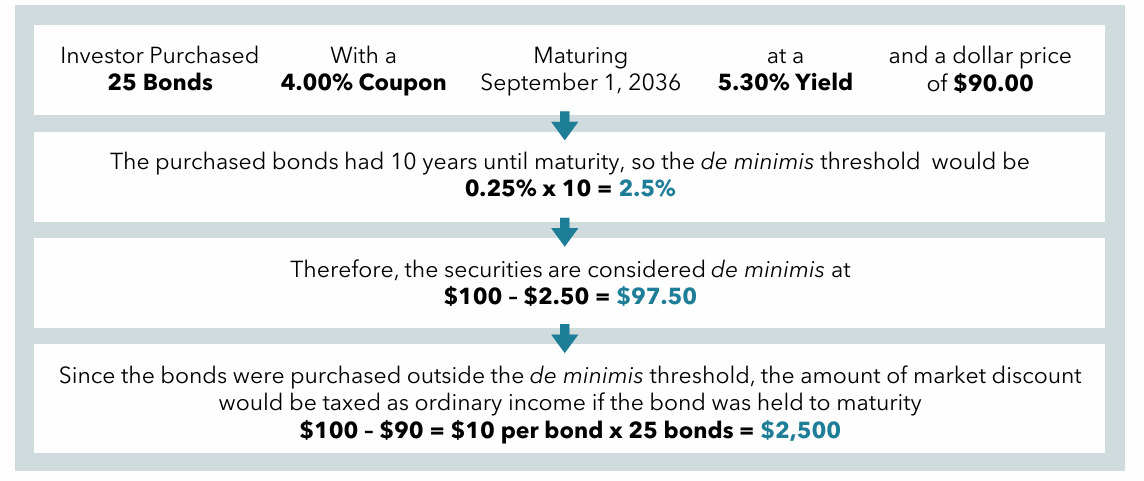
For example, suppose an investor purchases a 10-year tax-exempt bond at a price of $90 that was originally issued at par, or $100. The de minimis calculation is 0.25% multiplied by 10 complete years, producing an allowable discount of $2.50 and a threshold price of $97.50. Because the $10 market discount exceeds that amount, the bond’s accrued market discount would generally be taxed as ordinary income at maturity or disposition. This distinction becomes relevant whenever a bond is purchased at a market discount exceeding its calculated de minimis threshold.
What the De Minimis Rule Means for Investors Today
The recent increase in municipal yields has renewed the appeal of tax-exempt income while making the tax treatment of discounted bonds more consequential. Once a bond falls below its de minimis threshold, prospective buyers may demand additional yield to compensate for the less favorable tax treatment, placing further downward pressure on the bond's price. This creates a disconnect between existing holders and prospective buyers: a new buyer may face ordinary income treatment on future accretion, while an existing holder generally does not incur a new tax liability simply because the bond's market value has declined.
Implications for Municipal Portfolios
The de minimis rule can affect municipal portfolios in several ways, influencing bond pricing, tax-loss harvesting decisions, and the relative attractiveness of investment opportunities. The following considerations may be particularly relevant in today's yield environment.
- The de minimis pricing cliff. Consider a municipal bond originally issued at par with 10 complete years remaining to maturity and a de minimis threshold price of $97.50 per $100 of principal. A purchase at $97.60 generally results in $2.40 of gain receiving capital-gains treatment at maturity, whereas a purchase at $97.40 subjects the full $2.60 market discount to ordinary-income treatment. The difference in tax treatment applies to the entire discount, despite only a 20-cent difference in purchase price. Buyers may therefore demand an additional price concession to compensate for the greater tax liability, creating a pricing cliff whose magnitude depends on the bond and the purchaser’s tax circumstances.
- Tax treatment for existing holders. A decline in market value does not, by itself, create a de minimis tax liability for an existing holder. An investor who purchased a bond at par does not incur a new market-discount tax liability simply because the bond’s market price subsequently falls below its de minimis threshold. The coupon retains its tax treatment, and the issuer’s obligation to repay principal remains unchanged, subject to the issuer’s ability to meet that obligation. Where credit quality and investment objectives continue to support ownership, a price decline alone need not prompt a sale. However, the less favorable tax treatment facing prospective buyers may reduce the price an existing owner can receive when selling the bond.
- Tax-loss harvesting and reinvestment economics. Selling a bond below its de minimis threshold may require accepting a lower sale price because prospective buyers may demand additional yield to compensate for the bond's tax treatment. Although realizing the loss can provide an immediate tax benefit, the decision should also consider the after-tax yield available from replacement bonds. A lower reinvestment yield may reduce future income and partially offset the value of the harvested loss.
- Opportunity amid the repricing. The recent move higher in municipal yields has reflected broader interest-rate pressures and market technicals, including heavy new issuance and tax-loss selling, rather than a broad deterioration in municipal credit quality. Against this backdrop, intermediate and long municipal maturities offer yields near their highest levels in two decades. For investors with capital to allocate, the repricing may create opportunities to secure attractive tax-exempt income through selective purchases of high-quality municipal bonds. However, investors should look beyond stated yield and evaluate discounted bonds on an after-tax basis, as a portion of the return may be subject to ordinary income treatment under the de minimis rule. The MSRB specifically advises investors to consider whether the yield on a deeply discounted bond adequately compensates for its tax consequences and potential liquidity challenges.
The Role of a Separately Managed Account
A separately managed account allows municipal bonds to be evaluated at the individual holding level, taking into account the client's tax situation, income needs, and investment objectives. Unlike a mutual fund shareholder, an SMA investor owns the underlying bonds directly, providing greater flexibility in security selection and portfolio construction.
As discussed above, discounted bonds can present unique considerations related to de minimis thresholds, after-tax returns, and reinvestment decisions. At Davidson Investment Advisors, bond selection extends beyond evaluating yield, credit quality, and maturity. Discounted municipal bonds are also reviewed for their potential tax implications, including whether a purchase price falls below the de minimis threshold and could subject future accretion to ordinary-income treatment.
The current yield environment may create attractive opportunities to add municipal exposure, but not all yields are equal on an after-tax basis. Evaluating yield, credit quality, maturity structure, liquidity, and tax treatment together can help determine whether a discounted bond adequately compensates investors for its risks and tax implications while supporting the portfolio's income and investment objectives.
Davidson Investment Advisors is an SEC-registered investment adviser. Registration does not imply a particular level of skill or training or an endorsement by the SEC. This material is for informational and illustrative purposes only and does not constitute a recommendation to buy or sell any security or implement any investment strategy. It does not account for the financial circumstances, investment objectives or tax position of any particular investor.
The opinions and market outlook expressed herein reflect Davidson Investment Advisors’ views as of the publication date and may change without notice. Information obtained from trade and statistical services and other sources believed to be reliable has not necessarily been independently verified, and its accuracy or completeness is not guaranteed. Market conditions, yields and security availability may change. Statements concerning credit quality or investment opportunities are assessments rather than assurances of future results.
All investments involve risk, including the possible loss of principal. Municipal bonds are subject to interest-rate, credit, liquidity, call and reinvestment risks. Bond prices generally decline as interest rates rise, and a sale before maturity may result in a loss. Payment of interest and principal depends on the issuer’s ability to meet its obligations. Higher quoted yields may reflect additional risk or taxable components of return. Past performance does not guarantee future results. Indices are unmanaged, cannot be invested in directly and do not reflect the fees and expenses of an investment account.
Interest on tax-exempt municipal bonds is generally exempt from federal income tax, but state and local taxes may apply, and interest on certain bonds may be subject to the federal alternative minimum tax. Capital gains and market discount may be taxable even when coupon interest is tax-exempt. The de minimis discussion summarizes federal market-discount rules and does not address every exception or election. Tax treatment depends on the security, acquisition price, holding period and the investor’s circumstances, and tax laws and interpretations may change. Original issue discount is subject to separate rules.
Bond prices, yields and tax calculations presented as examples are hypothetical, do not represent current offerings or actual client results, and are not forecasts. The examples assume the stated purchase prices and maturities, repayment as described and, where indicated, an original issue at par. They simplify tax treatment and do not reflect advisory fees, transaction costs or all investor-specific tax considerations. Actual after-tax results may differ materially.
Tax-loss harvesting does not guarantee tax savings or an improved investment outcome. Any benefit depends on the investor’s ability to use the loss and must be considered alongside transaction costs, sale-price concessions and the return available from replacement securities. Wash-sale rules may disallow a loss when substantially identical securities are acquired within 30 days before or after a loss sale. Determining whether securities are substantially identical requires consideration of the relevant facts. Replacement bonds may not be available at comparable prices or yields.
A separately managed account provides direct ownership and opportunities for customization but does not guarantee favorable tax treatment, superior performance or protection from loss. Results depend on portfolio holdings, account restrictions, fees and individual circumstances. Nothing herein constitutes tax or legal advice. Investors should consult their own tax and legal advisers before acting on the strategies discussed.